

What Makes a Street Great for Trick or Treating and Everyday Living in Pinellas County
Halloween has a funny way of showing us what a street is really like.
On trick-or-treat night, the details stand out. Are there sidewalks? Is the street well lit? Do the homes sit close enough together that kids are not walking half a block between doorbells? Do cars pass through slowly, or does the road feel like a shortcut for everyone trying to get somewhere else?
Those same details matter long after the pumpkins come off the porch.
For buyers touring homes in Pinellas County, Halloween offers a simple lens for reading a street. A great trick-or-treating street often has the same qualities people appreciate year round: walkability, connection, comfort, and a sense that neighbors actually use the place they live.
That does not mean every buyer needs the same thing. Some people want privacy. Some want a quieter street with more space between homes. Others love a front-porch feel where neighbors wave, kids ride bikes, and dogs get walked around the block.
The point is to notice how the street works, not just how the house looks.

Sidewalks and street lighting tell you how easy the street feels to use
Sidewalks are one of the first things to notice when touring a home, especially in Pinellas County where many neighborhoods were built in different eras.
On Halloween, sidewalks make trick-or-treating easier. Kids can move from house to house without stepping into the road. Parents can walk beside them. Groups can pass each other without everyone squeezing onto the grass.
The same thing matters on a regular Tuesday.
A sidewalk can change how often people walk the dog, push a stroller, jog before work, or take an evening stroll after dinner. It can make the street feel more useful, not just more attractive. When sidewalks connect well, they can make a home feel tied into the surrounding area instead of tucked away from it.
Street lighting matters too.
Good lighting does not have to mean bright or harsh. It can simply mean the street has enough visibility to feel comfortable after sunset. That can matter during Halloween, but it also matters when someone gets home late, takes out the trash, checks the mail, or walks around the block in the evening.
When touring, try to visit at more than one time of day if you can. A street can feel very different at noon than it does after dark. Look for:
Whether sidewalks are present on one or both sides of the street
Whether sidewalks continue or stop suddenly
How visible driveways and intersections feel
Whether streetlights are spaced in a way that leaves long dark gaps
Whether tree cover blocks light in key areas
None of these details should be looked at in isolation. A street without sidewalks may still work well for someone who values a quiet, tucked-away setting. A well-lit street may still feel too busy if the traffic pattern does not fit the buyer’s lifestyle.
The goal is to ask, “How would I actually move through this street day to day?”
That question is useful on Halloween, and it is useful all year.
Homes that sit closer together can create a stronger street rhythm
For trick-or-treating, spacing matters.
When homes sit close enough together, the night flows. Kids can walk a few steps, ring the next bell, and keep moving. Porch lights, decorations, and neighbors chatting in driveways create a feeling of energy.
When homes sit farther apart, the experience changes. That can be perfectly fine, but it becomes more of a walk between stops than a steady neighborhood rhythm.
Buyers can learn from that.
The spacing between homes affects how a street feels every day. Closer homes can make it easier for neighbors to see each other, greet each other, and notice small routines. Someone watering plants might wave to the person across the street. A neighbor walking a dog might become a familiar face. Kids may have an easier time finding nearby playmates when homes are within sight of one another.
That kind of street rhythm can be a real plus for buyers who want connection.
Of course, close spacing is not automatically better. Some buyers prefer larger lots, deeper setbacks, or more privacy between homes. In parts of Pinellas County, lot size, home age, and street layout can vary quite a bit from one block to the next.
That is why touring with your eyes open matters.
Look beyond the curb appeal and notice the pattern:
Are front doors and porches visible from the street?
Do homes seem oriented toward the road, or set far back behind landscaping?
Are there usable front yards, patios, or driveways where people naturally spend time?
Do fences, hedges, or garages create privacy, or do they make the street feel more closed off?
Does the spacing feel comfortable for the lifestyle you want?
A good street has a rhythm that matches how someone wants to live.
For some, that means a friendly wave from the porch. For others, it means more room, more quiet, and fewer casual interactions. Halloween just makes the pattern easier to see.

Cul-de-sacs and low through traffic can change the pace of a street
Some streets feel like a destination. Others feel like a pass-through.
That difference can be especially clear on Halloween. Streets with low through traffic often feel calmer for families moving from house to house. Cul-de-sacs can create a natural gathering point, with fewer cars cutting through and more reason for neighbors to be outside at the same time.
That same layout can matter year round.
A cul-de-sac or low-traffic street may appeal to buyers who want a calmer setting. It can make bike riding, driveway chalk, dog walking, and casual neighbor chats feel more natural. It can also reduce the feeling that cars are constantly moving past the home.
But low through traffic is not only about the shape of the road.
A straight street can still be calm if it is not being used as a shortcut. A curved street can feel busier if it connects two popular routes. A cul-de-sac can feel peaceful, but it can also mean a little more turning around for guests, deliveries, or service vehicles.
The best question is simple: “Who uses this street, and why?”
When touring, notice the traffic pattern, not just the traffic count in that exact moment. Does the street seem like a route people take to get somewhere else? Is it near a school, park, shopping area, or larger road that might influence traffic at certain times? Are there speed humps, stop signs, curves, or narrow lanes that naturally slow cars down?
It can help to drive the area once during the day and once in the evening. If possible, visit on a weekday and a weekend. Pinellas County streets can change character depending on timing, weather, school schedules, nearby beach traffic, and local events.
A street does not need to be silent to be a good fit. Many buyers like being close to activity. The key is knowing whether the daily pace matches the way the home will be lived in.
Halloween gives you a quick preview. If the street feels easy to walk, easy to see, and easy to share, there may be something about the layout that supports everyday comfort too.
Neighbors being out tells you the street has a social life
One of the best signs on Halloween is simple: neighbors are outside.
They might be sitting in folding chairs in the driveway. They might be walking with their kids. They might be chatting across the sidewalk, handing out candy, or admiring decorations. No one has to be hosting a block party. Just being present can say a lot.
A street where people come out and recognize each other can feel different from one where everyone pulls into the garage and disappears.
For buyers, that can be a helpful thing to notice.
Do people seem to use their front yards? Are there porch chairs, plants, bikes, basketball hoops, or dog bowls that suggest people live a little bit out front? Do neighbors wave when someone walks by? Are homes cared for in a way that shows pride, even if each house has its own style?
These small details can point to a street where people are aware of each other.
That does not mean every buyer wants a highly social neighborhood. Some people prefer privacy and quiet, and that is a valid priority. But even buyers who keep to themselves often appreciate living on a street where neighbors notice when something seems off, share a friendly hello, or look out for one another in small everyday ways.
Halloween brings that social life into the open.
Year round, it may show up in quieter ways:
A neighbor bringing in a trash bin for someone who is away
People walking dogs around the same time each morning
Kids riding bikes in the late afternoon
A quick wave from someone watering plants
Front porch lights on in the evening
Seasonal decorations that show people enjoy their homes
These are not guarantees. They are clues.
A home tour usually focuses on bedrooms, kitchens, roofs, updates, insurance questions, and price. All of that matters. But the street is part of the home experience too. The feel of the block can shape daily life in ways that do not show up in listing photos.
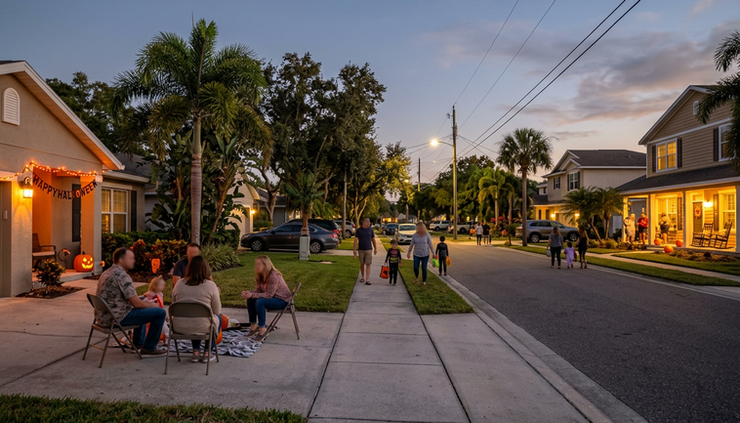
A Halloween lens can help buyers tour with more confidence
A house can check every box on paper and still not feel right once you stand on the street.
That is why the trick-or-treating lens is useful. It turns a once-a-year tradition into a simple way to read everyday living.
When you pull up to a home, pause before walking inside. Look left and right. Listen for traffic. Notice the sidewalks. Watch how the street handles movement. Pay attention to where people might naturally gather.
Ask yourself:
Would this street feel comfortable for an evening walk?
Is there enough lighting for the way I live?
Do the homes feel connected, private, or somewhere in between?
Does the traffic pattern fit my comfort level?
Do neighbors seem visible and present?
Does the street invite people outside, or does it feel more closed off?
Would I enjoy coming home to this block every day?
These questions are especially helpful because Pinellas County offers so many different street types. You can find quiet pockets, busier roads, waterfront areas, older blocks with character, newer communities, small lots, larger lots, and everything in between.
No single street style is right for everyone.
The right fit comes from matching the home, the block, and the buyer’s daily routine. Trick-or-treating simply highlights the details that are easy to miss when you are focused on countertops, flooring, and square footage.
For families, sidewalks and low traffic may rise to the top. For dog owners, walkability might matter most. For someone who works long hours, lighting and ease of parking may stand out. For a buyer who loves community, seeing neighbors outside might carry real weight. For someone who values quiet, the same activity level may feel like too much.
That is the value of slowing down and reading the street.
A good real estate tour should include the home and the setting around it. The view from the driveway, the walk to the mailbox, the sound of cars passing, the distance between front doors, and the way neighbors use the block all help tell the story.
Halloween just makes the story easier to see.
The takeaway for Pinellas County buyers
A great trick-or-treating street usually has more going for it than candy.
It often has sidewalks that support walking, lighting that makes evenings easier, homes close enough to create a steady rhythm, street layouts that reduce pass-through traffic, and neighbors who are out enough to know each other.
Those same qualities can shape daily life long after Halloween is over.
So the next time you tour a home in Pinellas County, spend a few extra minutes outside. Walk a short stretch of the street if you can. Look at how the homes relate to one another. Notice whether the block feels active, quiet, connected, private, or somewhere in the middle.
The right home is not just the one with the floor plan you like. It is also the one on a street that fits the way you want to live.
If you are buying or selling in Pinellas County and want a local team that pays attention to both the house and the neighborhood feel, call The Straight Team at 727-216-9441.


Comments